
San Clemente City Directories in Three Verified Years
The strongest documented San Clemente city directory evidence comes from the National Archives' Orange County list. It identifies countywide volumes for 1926, 1929, and 1931 and expressly includes San Clemente along with other county places. The volumes were gathered as aids for 1930 census research, which makes the sequence especially useful: a 1929 entry can be paired with the 1930 enumeration and checked again in 1931. A 1926 entry may catch the planned settlement before incorporation.
| Collection | Verified Years or Scope | Where Held | Access |
|---|---|---|---|
| Orange County city directories | 1926, 1929, 1931; San Clemente included | National Archives microfilm program | Consult the county volume and locality heading |
| United States City and Business Directories | About 1749 through about 1990; locality and year vary | FamilySearch | Free account may be needed for images |
| Laguna Beach and San Clemente City Directory | 1951 independently cataloged | Major genealogy catalogs; verify with OCPL or FamilySearch | Edition and image rights need confirmation |
| San Clemente Sun-Post | 1937-2021 | OCPL Digital Newspapers | In-library viewing, printing, and download |
| San Clemente News | 1987-1989 | OCPL Digital Newspapers | In-library access |
| El Heraldo de San Clemente | Title confirmed; issue dates not stated on the branch landing page | OCPL Digital Newspapers | In-library access; verify the issue run |
| Orange County directories and historic newspapers | Exact local run not itemized online | Orange County Archives | Ask for a box or volume list before travel |
The table separates verified coverage from leads that still need a catalog check. Do not turn the single 1951 catalog record into a continuous annual series, and do not infer a publisher when the title page has not been inspected.
Where San Clemente Directory Shelves and Film Live
The San Clemente Library is the practical local starting point for newspapers, microfilm, fiche, genealogy databases, and staff routing. The branch lists a microfilm and fiche machine and provides local access to digitized newspapers. OCPL's Digital Newspapers collection is in-library only, but viewing, printing, and downloading are permitted. An eligible library card can also open Ancestry Library Edition, Fold3, and HeritageQuest inside a branch or through the stated card rules.
Orange County Archives is the deeper physical fallback. Its holdings include Orange County directories, local historic newspapers and magazines, photographs, property material, and pre-1960 county records. The Archives is in Old Orange County Courthouse Room 108, 211 W. Santa Ana Boulevard, Santa Ana, with 714-834-2536 and published weekday hours of 9:00-noon and 1:00-4:30. A noon closure affects travel from San Clemente, so call for a volume or box list first.
The branch page gives the local access context for a San Clemente historical search.
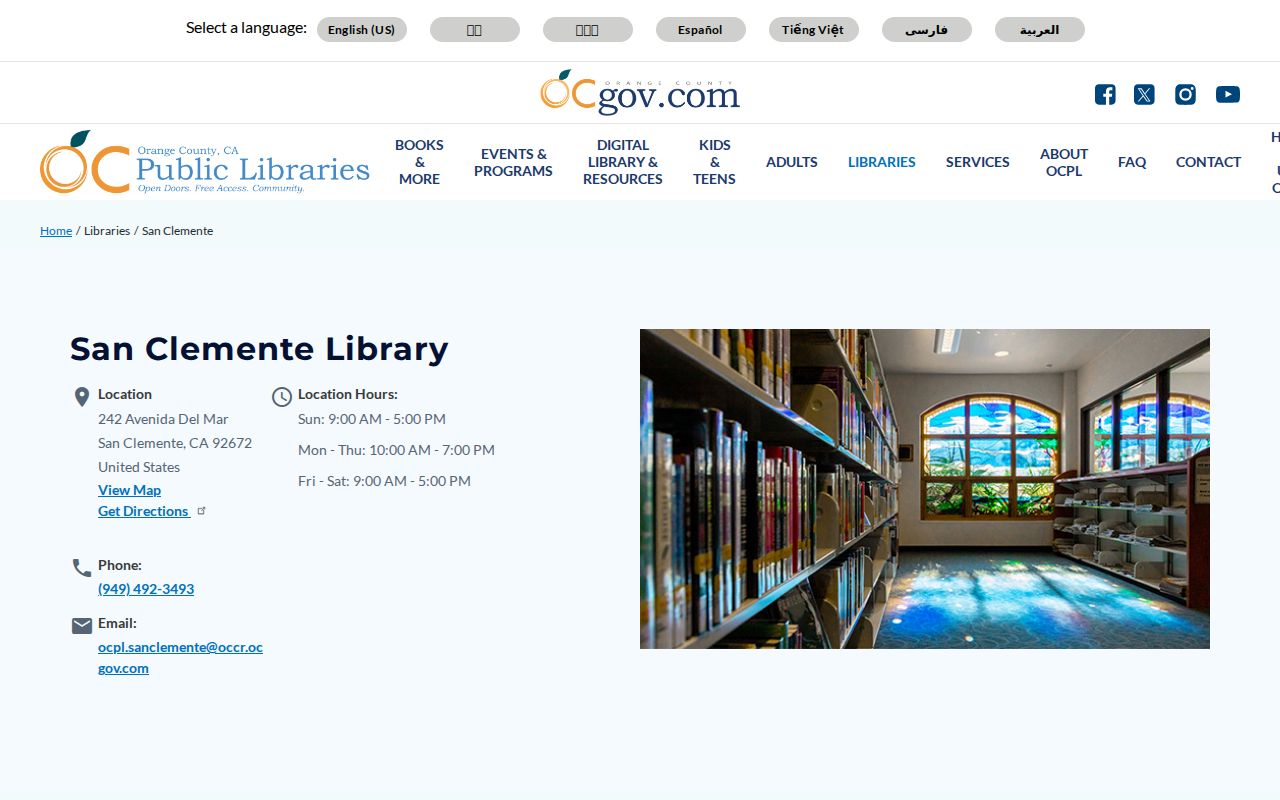
Library access can identify a shelf, machine, or licensed database. It does not mean every digitized title is open from home or that a staff member can perform an unlimited search.
Reading a San Clemente City Directory Entry
An older city directory entry must be read in the context of its edition. The official catalogs did not deliver an openly viewable San Clemente personal page during research, so no sample resident is fabricated. Open the title and copyright page first, then locate the San Clemente locality heading. Record the edition, publisher, page, and any front-matter key before expanding abbreviations.
| Name | Surname and given name or initials; compare spelling and name order across years. |
|---|---|
| Family clue | Spouse in parentheses, widow notation, or a “see” cross-reference when supplied by that edition. |
| Occupation | Published trade or affiliation, useful as an identity clue rather than a residence proof. |
| Address | House number and street, with local abbreviations that must be decoded from the volume. |
| Owner or renter mark | Some publishers use a symbol or letter; meaning varies and must be checked in that volume. |
| Reverse section | A street or address section may exist, but local availability must be verified rather than assumed. |
- Criss-cross directory
- An address-first or street-order section that reverses the usual name-to-address arrangement.
- Householder index
- A name-based listing of a household head or address holder for a particular publication snapshot.
- Abbreviation key
- The edition's front-matter guide to short forms for occupations, streets, relationships, and marks.
- Index versus image
- An index points to a likely entry. The volume image supplies the actual wording, context, and page citation.
A directory can be a strong lead. It remains a dated publication, not a continuous census of San Clemente households.
Trace a San Clemente Household Across Years
Following one household across city directory years is a comparison task. Use the same spelling only as a starting point. Initials, a spouse, an occupation, an address, and a later obituary can separate namesakes. A disappearance can mean a move, death, unlisted status, a publication gap, a changed street label, or an index error. Keep those explanations open until a second source supports one.
- Start with the best-known name, address, spouse, or occupation and locate the locality section in a verified San Clemente city directory edition.
- Photograph or cite the title page, page number, entry, and abbreviation key before transcribing the record.
- Move forward or backward to another verified year, noting address changes, spouse changes, widow marks, initials, and business references.
- Pair each directory snapshot with a nearby census, newspaper, permit, deed, obituary, or probate record.
- Mark a missing year as an unresolved gap rather than treating the absence as proof that the household left.
The 1929 and 1931 Orange County volumes bracket the 1930 census particularly well. The 1926 volume can establish an earlier presence near the town's first planned years. Use the address or legal description to keep the household distinct from a same-name entry in another county place.
Pair San Clemente City Directories with Census Years
Directories fill the years between federal census schedules. NARA's public census material runs through 1950 as of 2026 under the 72-year release rule, and 1960 is scheduled for 2032. For San Clemente, the 1930, 1940, and 1950 schedules are the key public household snapshots. Census entries can show age, birthplace, relationship, occupation, and an enumeration-district or address clue. A directory adds a publication-era address or business clue, but the two sources are separate reports.
Use the directory to suggest a name and address, then find the corresponding enumeration district or street page. NARA cautions that census accuracy depends on the informant. Directories also contain omissions, spelling errors, unlisted households, and publisher choices. Pairing them is stronger than treating either source as a complete San Clemente city directory.
NARA census guidance explains the released schedules and search clues. FamilySearch's directory collection exposes first name, last name, birthplace, birth year, and more-options fields, but locality and image availability vary.
San Clemente Newspapers Fill Directory Gaps
When the San Clemente city directory run breaks, local newspapers often supply the missing date or relationship. OCPL's confirmed Sun-Post run spans 1937-2021, and San Clemente News covers 1987-1989. El Heraldo is confirmed as a title, although the branch page does not state its issue dates. Search social notices, marriage announcements, business advertisements, addresses, community events, and obituaries. Neighboring-community newspapers can matter when a household crossed the city line.
OCPL's obituary guide points to the California Death Index 1940-1997, Social Security Death Index, NewsBank and Orange County Register material after January 1, 1987, as well as branch assistance. An obituary can explain why a name drops out of a directory and may identify relatives or a later place, but relationships and dates should be corroborated with vital, probate, cemetery, or family records.
The newspaper shelf is a bridge between a printed directory and a later resident lookup. Preserve the title, issue date, page, and exact wording so a future researcher can distinguish a notice from a confirmed record.
March 1929 Sanborn Maps beside the San Clemente Directory
San Clemente's 2006 Historic Structures Survey cites March 1929 Sanborn Insurance Maps and describes local services shown on the sheets, including a grocery, drug store, cobbler, bank, plumbing shop, bakery, auto repair, beauty shop, billiard hall, restaurants, and hotels. The map is a structure and location companion to the 1929 city directory. It can show a footprint, building use, or historic street label. It does not identify every person who occupied the building.
The City survey verifies the March 1929 reference. The Library of Congress Sanborn guide explains that catalog entries can identify city, edition date, sheet count, notes, and digital files, but not every 1923-1930 sheet is digitized. Compare lot, footprint, business, and adjacent street clues, then use the legal description or APN for continuity.
The Archives address and holdings page is the best physical fallback when a map or directory image is not openly available.
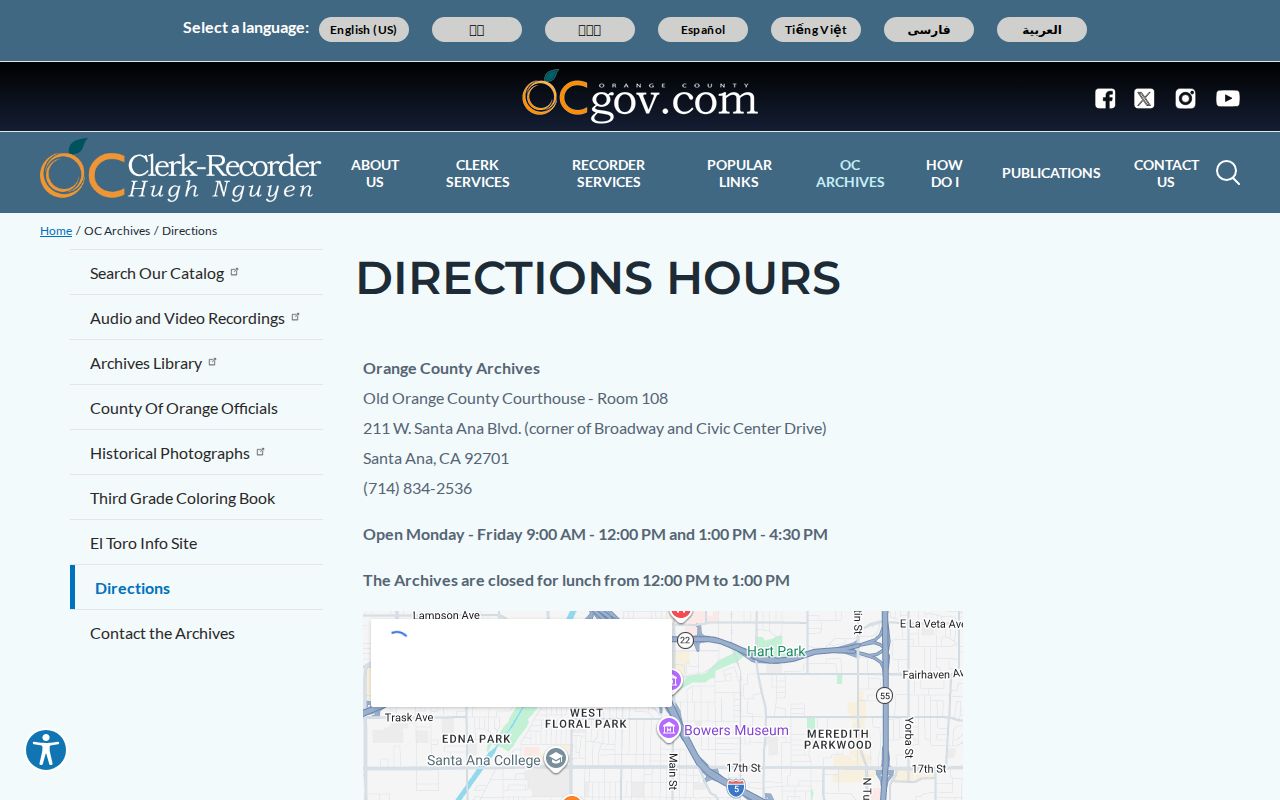
Archives research can connect the printed directory, property history, and county context, but an appointment or volume check may be needed before travel.
Preserve San Clemente Family Evidence at OCPL
The OC Memory Lab at the San Clemente Library is an unusual companion to a San Clemente city directory search. It offers free do-it-yourself sessions for family documents, photographs, film, tape, and audio or video formats supported by the lab. A library card, waiver, reservation, and user-supplied external storage are required. Sessions last three hours, and the research notes that reservations are limited to two sessions in seven days and one per day.
Digitizing a private letter, photograph caption, family address book, or old directory page can preserve clues that are not in a government roll. The Memory Lab does not create a public name index, and it does not make a private family record public. Keep consent and personal-privacy choices with the family material.
The local lab's source page shows the preservation route that can strengthen a family-history file without overstating what a public directory contains.
Use the preserved file as a cited family source, then corroborate names and dates through the appropriate library, county, or state custodian.
San Clemente City Directory Research Boundaries
Official catalogs verify important years but leave real gaps. The NARA list does not expose a San Clemente entry image, title page, publisher, reverse-directory availability, or complete later run. The 1951 Laguna Beach and San Clemente catalog record needs edition and image confirmation. Orange County Archives has directories, but its online pages do not itemize every title or call number. These are research gaps, not permission to fill in a publisher or year.
Best practice. Cite the exact edition, locality heading, page, repository, and access condition. Label a catalog lead as a lead until the volume or image is inspected.
A San Clemente city directory can establish that a publication listed a name and address at a particular time. It cannot prove continuous occupancy, current residence, or the identity of every household member. For modern parcel work, use the address-keyed workflow; for one person, use the San Clemente resident lookup route and corroborate the historical entry with current records.